-RGB.jpg?w=1413&h=279)
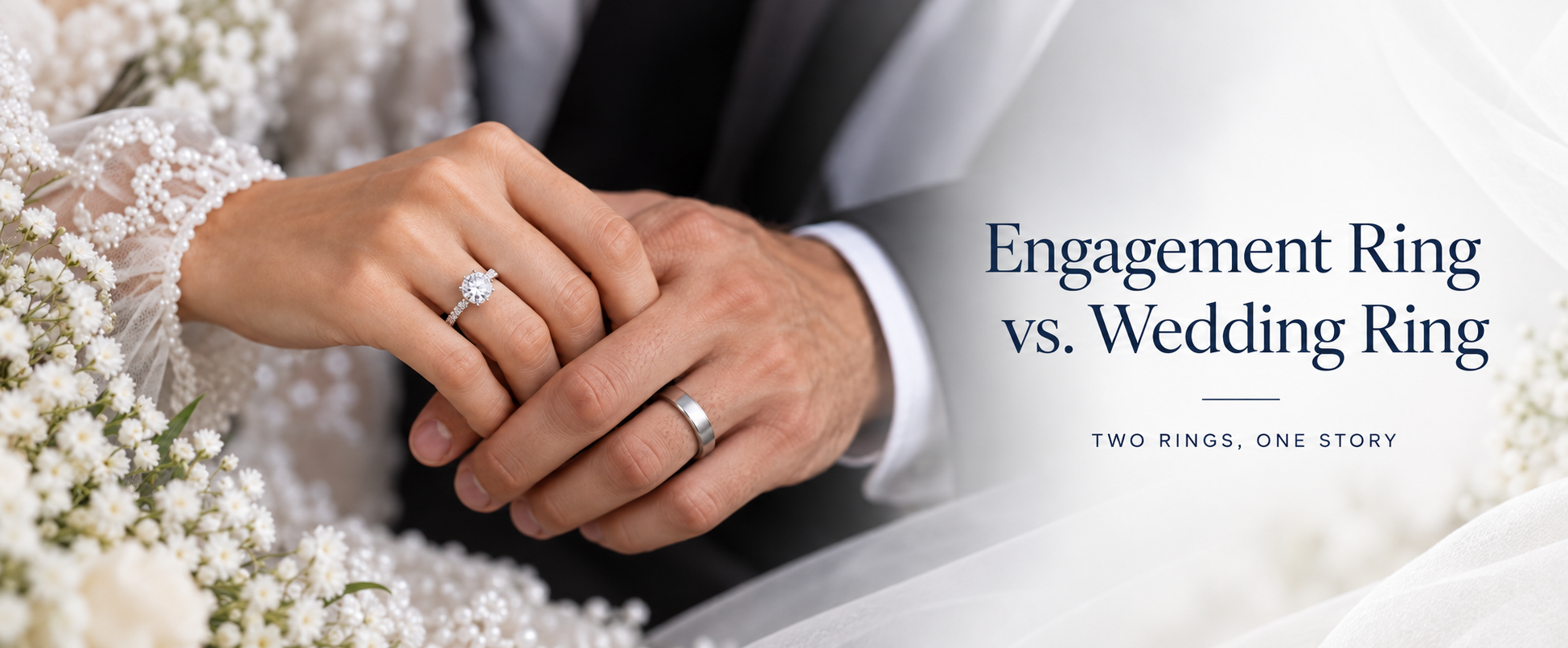
Engagement rings and wedding rings both symbolize commitment, but they mark different moments in a relationship.
An engagement ring is usually given during a proposal and often features a prominent center stone. A wedding ring, also called a wedding band, is traditionally exchanged during the wedding ceremony and tends to have a simpler, more wearable profile.
Today, those rules are much more flexible. Some couples wear both rings together, some choose only one, and others build personalized stacks around moissanite engagement rings and matching bands. GIA notes that modern couples increasingly choose the combination that feels most meaningful and practical for them.
What Is an Engagement Ring?
An engagement ring represents the promise to marry.
Visually, it is usually the more decorative ring of the pair. A center gemstone often becomes the focal point, supported by a solitaire, halo, channel, pavé or three-stone setting.
A classic round cut engagement ring is one of the easiest examples. Round stones create a balanced, recognizable silhouette and work with both simple solitaire bands and more detailed settings. MomentWish currently offers round-cut styles in solitaire, channel-set, halo and twisted designs.
A pave engagement ring creates a different look. Instead of relying only on the center stone, small stones are set along the band to extend the sparkle across the finger. GIA describes pavé as a setting style that uses many small gemstones close together to create a continuous sparkling surface.
For example, MomentWish’s Twisted Vine Pavé Engagement Ring combines a 1-carat round moissanite center stone with smaller pavé-set side stones and a twisting band.
What Is a Wedding Ring?
A wedding ring marks the marriage itself.
It is traditionally exchanged during the wedding ceremony and is usually designed for regular, long-term wear. While some wedding bands are completely plain, others include pavé stones, channel-set stones, curved silhouettes or eternity designs.
MomentWish’s Moissanite Wedding Rings collection includes half-pavé, seven-stone, curved, ribbon and twisted-vine bands, along with wider tungsten options for men.
A simple wedding band often sits beside the engagement ring rather than competing with it.
That is why slim round wedding rings and curved bands are popular choices: they can visually frame the engagement ring while remaining comfortable enough for everyday wear.
MomentWish’s Half Pavé Eternity Wedding Band, for example, is only 1.3mm wide and uses 15 round moissanite stones, specifically giving it a delicate profile that can complement an engagement ring.
Engagement Ring vs. Wedding Ring: The Main Differences
| Feature | Engagement Ring | Wedding Ring |
|---|---|---|
| When it is given | Proposal | Wedding ceremony |
| Main meaning | Promise to marry | Marriage and commitment |
| Typical design | Center stone + setting | Band or continuous stones |
| Visual impact | Usually more prominent | Usually more understated |
| Everyday wear | Often worn daily | Designed for regular wear |
| Worn together? | Often | Often paired with engagement ring |
The easiest way to remember the difference is:
The engagement ring marks the proposal; the wedding ring marks the marriage.
Do You Need Both Rings?
No.
Tradition may suggest an engagement ring followed by a wedding band, but modern couples do not have to follow that formula.
GIA explains that some people wear both rings every day, while others wear only the wedding band regularly and save the engagement ring for special occasions. Some even wear the rings on different hands or build larger ring stacks.
Lifestyle matters.
If you work with your hands or prefer minimal jewelry, one comfortable band may be enough. If you enjoy jewelry and symbolism, wearing both creates a layered look that represents two different stages of the relationship.
For couples choosing moissanite engagement rings, adding a matching moissanite band can keep the brilliance and stone color consistent across the set.

How Should an Engagement Ring and Wedding Band Fit Together?
The best pair should look intentional and feel comfortable.
Start with the engagement ring because it normally determines the shape and proportion of the stack.
A solitaire with a raised setting can usually sit beside a straight band. A halo or low-set center stone may leave a small gap, so a curved wedding band can fit around it more naturally.
GIA recommends choosing a wedding band that complements the engagement ring rather than competing with it. A large center stone, for example, can pair well with a thinner detailed band.
MomentWish’s earlier guide to solitaire, channel-set and eternity rings also highlights how each style carries a different balance of symbolism and visual detail.
If your engagement ring already has a detailed pavé shank, a simpler wedding band can create balance.
Why Moissanite Works for Both Rings
Using the same gemstone family across an engagement ring and wedding band can create a more cohesive set.
MomentWish offers moissanite engagement rings in solitaire, pavé, channel, halo, three-stone and other settings, while its wedding collection uses moissanite in half-eternity, curved and multi-stone bands.
This allows couples to choose either a matching look or a controlled contrast.
For example:
- solitaire engagement ring + pavé wedding band
- halo engagement ring + plain band
- channel-set engagement ring + matching channel band
- round engagement ring + curved eternity band
The rings do not need to be identical. They simply need to feel related.
Which Ring Goes on First?
Traditionally, the wedding band is worn closest to the hand, followed by the engagement ring.
This arrangement places the wedding band—symbolizing the marriage—closest to the heart. GIA notes, however, that modern couples also reverse the order or wear the rings on different hands based on comfort and personal preference.
So there is no styling police waiting to inspect your left hand.
Choose the order that feels natural and keeps both rings secure.
How to Choose Between Different Styles
Think about how much visual detail you want.
A pave engagement ring works well if you want sparkle across the entire upper surface of the ring. MomentWish’s Twisted Vine design uses a round 1-carat moissanite with 16 smaller side stones.
A solitaire feels cleaner.
A channel-set design creates a structured line of stones protected between metal walls; GIA notes that channel settings are commonly used for both wedding bands and engagement-ring accent stones.
For the wedding band, decide whether you want it to disappear quietly beside the engagement ring or contribute additional sparkle.
Neither approach is more correct.
Two Rings, One Story
The real difference between an engagement ring and a wedding ring is not simply design.
Each represents a different moment.
The engagement ring says, “We are choosing a future together.”
The wedding band marks the commitment that follows.
Whether you choose a classic round cut engagement ring, a detailed pavé style, a slim eternity band or only one ring altogether, the best combination is the one that fits your relationship, lifestyle and personal taste.
FAQ
1. What is the difference between an engagement ring and a wedding ring?
An engagement ring marks the proposal, while a wedding ring is exchanged during the marriage ceremony.
2. Do you need both an engagement ring and wedding band?
No, couples can wear both, only one, or create their own ring combination.
3. Which ring goes on first?
Traditionally the wedding band goes on first, followed by the engagement ring.
4. Can a wedding band have stones?
Yes, wedding bands can include pavé, channel-set, eternity or other gemstone designs.
5. Should the engagement ring and wedding band match?
They do not have to match exactly, but complementary metal tones, shapes and proportions usually create a more cohesive stack.