-RGB.jpg?w=1413&h=279)

Choosing a moissanite ring can feel complicated when product descriptions start listing cut, color, clarity and carat all at once.
The good news is that you do not need to chase the highest specification in every category. The best moissanite ring is the one that balances sparkle, appearance, size and setting with your personal style.
The familiar “4Cs” framework—cut, color, clarity and carat weight—was created by GIA for diamonds, but these four ideas are still useful when comparing moissanite jewelry. Just remember that moissanite is a different gemstone with its own optical characteristics.
Here is what each factor actually means when you are shopping.
1. Cut: Start With the Sparkle
Cut has one of the biggest visual effects on a gemstone because it determines how light interacts with the facets.
For diamonds, GIA explains that facet proportions influence brightness, fire and scintillation. The same basic optical idea helps when comparing moissanite: a well-proportioned stone usually looks livelier and more balanced than one with awkward facet relationships.
Round brilliant remains one of the easiest choices if sparkle is your priority. Its symmetrical shape also works with almost every engagement-ring style.
A round cut engagement ring is especially useful for buyers who want something classic rather than trend-driven. MomentWish currently uses round moissanite across solitaire, halo, channel-set and side-heart designs. Explore round-cut moissanite styles
Other shapes such as cushion, princess or heart can create a more distinctive look, but shape preference should come before trying to maximize a technical specification.
Best rule: choose the shape you genuinely like, then look for balanced symmetry and lively light return.
2. Color: How White Do You Want the Stone to Look?
Moissanite can range from colorless to near colorless.
GIA notes that some stones may show slight yellow or gray tones from particular angles, while higher-colorless material appears brighter and more neutral.
MomentWish frequently describes its current engagement-ring stones as D color, including its solitaire, halo and pavé designs.
For white-metal settings such as sterling silver or white gold finishes, a very colorless-looking stone creates a clean, icy appearance.
Warm metal tones can be more forgiving. Rose gold and yellow gold naturally introduce warmth around the stone, so a perfectly icy appearance may feel less essential.
Do not choose color in isolation—consider the metal surrounding it.
3. Clarity: Look for a Clean Appearance, Not a Label
Clarity describes internal characteristics and surface imperfections.
With moissanite, most jewelry-quality stones are already clean enough that imperfections are difficult to notice without magnification. GIA describes moissanite as generally having only minor imperfections in many jewelry examples.
MomentWish currently lists many rings as VVS1 clarity, including its four-prong solitaire and twisted pavé styles.
That specification sounds impressive, but the practical buying question is simpler:
Does the stone look clean to the naked eye?
For most buyers, visual cleanliness matters more than chasing increasingly technical clarity terminology.
This is also why a simple solitaire can be helpful when evaluating the center stone—the design leaves little to distract from it.
MomentWish's moissanite four-prong solitaire engagement ring for women uses a round 1- or 2-carat-equivalent center stone with D color and VVS1 clarity in a four-prong setting. View the four-prong solitaire ring
4. Carat: Think About Size and Proportion
Carat is where moissanite shopping can become confusing.
With diamonds, carat refers to weight. With moissanite, retailers often use “carat” or “carat equivalent” to make the stone's approximate visual size easier for diamond shoppers to understand.
That means you should pay attention to how large the stone actually looks on the hand rather than focusing only on the number.
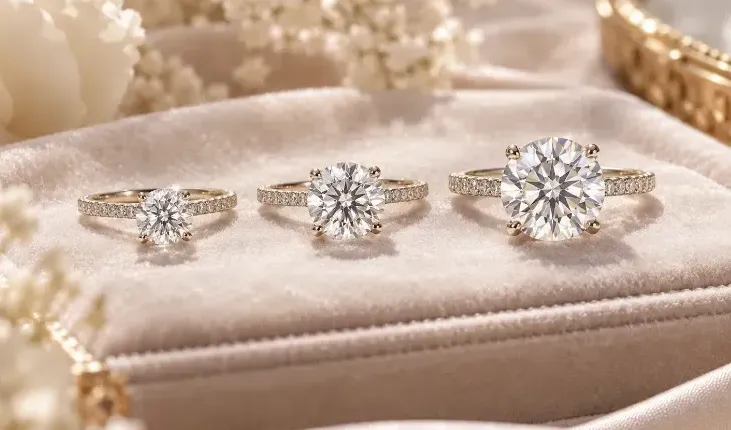
A 1-carat-style center stone creates a traditional engagement-ring proportion. A 2-carat-style stone looks much more noticeable and can make moissanite's strong fire even more visible. GIA notes that larger moissanite can display especially intense rainbow fire.
MomentWish's four-prong solitaire is currently offered in both 1- and 2-carat options, making it easy to compare the visual difference within the same setting.
Think about finger size, band width and lifestyle too. A larger center stone may look dramatic, but a smaller stone can feel easier for everyday wear.
5. Setting Changes How the Stone Looks
The gemstone specifications are only half the decision.
The setting can make the same size stone appear completely different.
A solitaire keeps attention on the center stone.
A halo visually enlarges the center.
Channel-set stones add structured sparkle along the band.
Pave engagement rings create a softer shimmer because small stones continue across the surface of the band.
MomentWish's twisted-vine pavé style combines a 1-carat round moissanite with 16 smaller side stones, producing more overall sparkle than a plain solitaire while keeping the center stone dominant.
If you are unsure which setting suits your lifestyle, MomentWish's existing engagement-ring settings guide also compares solitaire, halo, channel, pavé and other structures in more detail.
6. Choose Based on Purpose
Not every moissanite ring needs the same specifications.
A moissanite promise ring can be smaller and more delicate because symbolism is often more important than maximum center-stone size.
An engagement ring may place more emphasis on cut and visual presence.
Wedding bands are different again. Round wedding rings with smaller moissanite stones can complement an engagement ring without competing with it. MomentWish currently offers half-pavé, seven-stone, ribbon and curved moissanite wedding bands.
The right specifications depend on what role the ring will play.
Quick Moissanite Buying Comparison
| Factor | What to Look For | Why It Matters |
|---|---|---|
| Cut | Balanced facets and lively sparkle | Biggest visual impact |
| Color | Colorless or near-colorless appearance | Affects how white the stone looks |
| Clarity | Eye-clean appearance | Keeps the stone visually crisp |
| Carat/Size | Proportion on the hand | Controls visual presence |
| Setting | Solitaire, halo, pavé or channel | Changes overall sparkle and style |
The Best Combination
For most buyers, there is no need to maximize every category.
Prioritize cut and overall appearance first, then choose a color that works with your metal, clarity that looks clean to the eye and a carat size that feels comfortable.
A well-balanced 1-carat solitaire can look more elegant than a much larger stone in a setting you do not love.
Moissanite buying should ultimately be about how the ring looks on your hand—not how impressive the specification list sounds.
FAQ
1. What is the best cut for a moissanite ring?
Round brilliant is one of the most popular choices for strong sparkle and a timeless engagement-ring look.
2. Is D color good for moissanite?
Yes, D-color-labeled moissanite is intended to offer a very colorless-looking appearance.
3. Is VVS1 clarity necessary for moissanite?
Not necessarily; an eye-clean stone is usually more important than maximizing a clarity label.
4. Is 1 or 2 carats better for a moissanite engagement ring?
One carat gives a classic proportion, while two carats creates a larger and more noticeable statement.
5. Should I choose the stone or setting first?
Choose your preferred stone shape first, then select a setting that complements its size and your lifestyle.