-RGB.jpg?w=1413&h=279)
.png?w=1950&h=807)
Choosing an engagement ring is not only about the gemstone. The setting—the way one or more stones are arranged and secured—has a major influence on how the ring looks, how much it sparkles and how practical it feels for everyday wear.
Some settings keep the focus on one center stone, while others create extra brilliance with side stones, halos or pavé details. Understanding the main engagement ring settings can make it much easier to choose a style that reflects both your personality and your lifestyle.
Solitaire: Simple, Timeless and Focused
A solitaire setting features one center gemstone with no surrounding side stones. It remains one of the most recognizable engagement ring styles because the design keeps all attention on the main stone.
Prongs are commonly used to hold the center stone, allowing more of the gem to remain visible. GIA notes that solitaire rings can use prong, bezel, cathedral or tension-style settings depending on the desired look and level of protection.
Solitaire designs are ideal for someone who prefers clean lines, minimal detailing and easy pairing with a wedding band. They also make a strong foundation for dainty moissanite jewelry because a slim band can make the center stone feel more prominent.
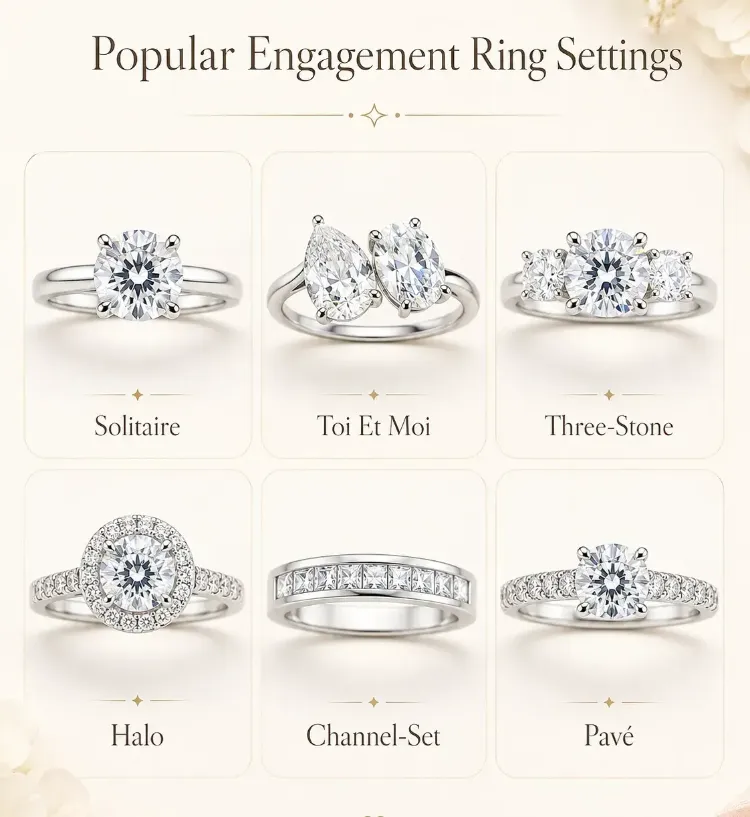
Toi Et Moi: Two Stones, One Story
“Toi Et Moi” means “you and me” in French. These rings feature two center stones placed together, symbolizing two individuals becoming one partnership.
The stones do not need to match. A heart and emerald shape, for example, can create a softer-meets-structured contrast, while two round stones produce a more symmetrical look.
For couples who want a ring with stronger storytelling, toi et moi engagement rings offer a more expressive alternative to traditional single-stone designs.
This style works especially well for anniversaries and milestone gifts because each stone can represent one person, one chapter or one meaningful moment.
Three-Stone: Past, Present and Future
Three-stone rings typically feature one larger center stone flanked by two smaller stones. The style is often associated with the past, present and future of a relationship.
GIA notes that three-stone designs commonly use prong or bezel settings and that the center stone is generally larger than the two side stones.
MomentWish’s Three-Stone Channel Set Engagement Ring combines three round moissanite center stones with smaller stones along the band, creating both symbolism and additional sparkle.
Three-stone rings are especially appealing to couples who want more visual presence than a solitaire without moving into a full halo design.
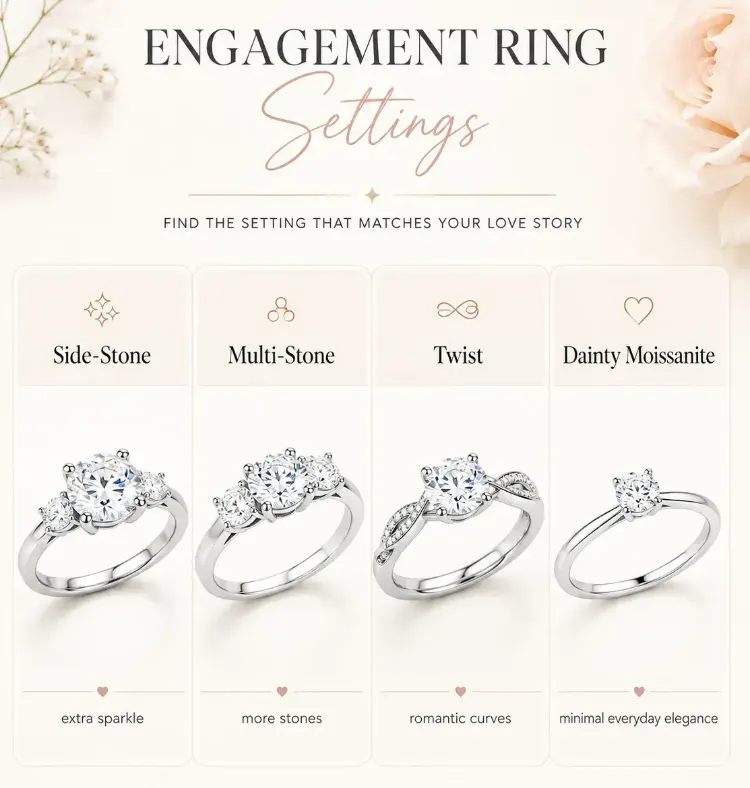
Multi-Stone and Side-Stone Settings
Multi-stone settings use several gemstones to create a decorative composition rather than relying on one dominant center stone.
Side-stone rings are slightly different: they still feature a central gemstone, but additional stones are positioned along the shoulders of the ring to enhance its overall brilliance.
GIA identifies prong, channel and bar-channel settings as common options for securing side stones. Channel settings keep smaller stones more flush with the band, while bar-channel designs allow more light to enter from the sides.
This style is useful if you want extra sparkle without surrounding the entire center stone.
Halo: Bigger-Looking Brilliance
A halo setting places a circle—or sometimes two circles—of smaller gemstones around the center stone.
The main appeal is visual impact. A halo can make the center stone appear larger and increase the total amount of sparkle without requiring a significantly larger center gemstone. GIA specifically notes that halo settings can create the impression of a larger stone.
MomentWish offers halo designs in round, cushion and heart-shaped center stones. A Halo Round Cut Channel Set Engagement Ring, for example, combines a center moissanite with a surrounding halo and channel-set accents along the band.
If you prefer a romantic, high-sparkle look, halo settings are one of the easiest ways to create it.
Channel-Set: Sleek and Secure
Channel settings place small stones between two parallel strips of metal, creating a smooth row of sparkle across the band.
Because the stones sit lower and are protected by metal edges, this style can feel practical for everyday wear. GIA describes channel settings as a way to protect side stones by keeping them more flush with the ring.
MomentWish’s channel set engagement rings pair this technique with solitaire, halo and three-stone center designs.
This setting works particularly well for someone who likes sparkle but does not want tiny prongs covering every accent stone.
Pavé: Fine Sparkle Across the Band
Pavé comes from the French word for “paved.” In jewelry, tiny stones are set closely together so the surface appears covered with continuous sparkle.
GIA explains that pavé settings use many small stones placed closely into the metal, creating the effect of a bright, uninterrupted surface.
pave engagement rings are a good choice if you want the center stone to remain dominant while adding delicate brilliance along the band.
A pavé band also pairs beautifully with twisted or vine-inspired designs, since the small stones can follow the curves of the ring.
Twist and Vine Settings: Movement and Romance
A twist ring uses two or more bands that curve around each other, creating movement and visual softness. When pavé stones are added, the twisting lines become more pronounced.
MomentWish currently offers twisted-vine pavé engagement rings with side-heart details, combining a romantic motif with extra surface sparkle.
Twist designs are especially suitable for someone who wants something more decorative than a straight band but less structured than a halo.
They also work well for symbolic jewelry because the intertwined lines can represent two lives moving together.
Which Engagement Ring Setting Is Best for You?
| Setting | Look | Sparkle Level | Best For |
|---|---|---|---|
| Solitaire | Clean and classic | Medium | Minimalists and timeless style |
| Toi Et Moi | Artistic and symbolic | Medium–High | Unique love stories |
| Three-Stone | Meaningful and balanced | High | Past-present-future symbolism |
| Side-Stone | Elegant and detailed | High | Extra sparkle without a halo |
| Halo | Romantic and dramatic | Very High | Bigger-looking center stones |
| Channel-Set | Smooth and structured | High | Everyday wear and security |
| Pavé | Delicate and bright | Very High | Fine sparkle across the band |
| Twist/Vine | Soft and romantic | High | Decorative, feminine styling |
The best setting depends on how you actually live. Someone who works frequently with their hands may prefer a lower, more protected design. Someone who prioritizes sparkle may prefer halo or pavé. A minimalist may be happiest with a solitaire.
If you are still comparing settings with gemstone shapes, MomentWish’s moissanite cuts and shapes guide explains how round, cushion, princess, emerald, heart and pear stones behave visually in different designs.
Setting Choice Matters as Much as Stone Choice
The setting determines how the gemstone is framed, how much light reaches it and how secure it feels in daily life.
GIA recommends balancing beauty with practicality when choosing an engagement ring, especially when deciding between prong, bezel, halo, pavé, channel and multi-stone styles.
A well-chosen setting should feel like part of your story rather than simply a technical detail. Whether you prefer one stone, two stones or a full band of sparkle, the right structure is what turns a gemstone into a ring you will want to wear every day.
FAQ
1. What is the most popular engagement ring setting?
Solitaire remains one of the most classic choices, while halo, pavé and three-stone settings are also widely popular.
2. Is a channel setting good for everyday wear?
Yes, channel-set stones sit relatively flush with the band and receive added protection from the surrounding metal.
3. What is the difference between pavé and channel-set?
Pavé uses tiny stones held closely by small beads or prongs, while channel-set stones sit between two strips of metal.
4. Does a halo make a center stone look bigger?
Yes, the surrounding stones can create the visual impression of a larger center gemstone.
5. What does a Toi Et Moi ring symbolize?
The two center stones traditionally represent two people coming together as one couple.